
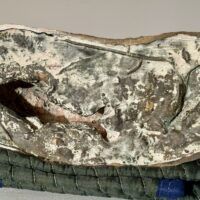
Phyllis Mary Bone RSA (Scottish, 1894-1972)
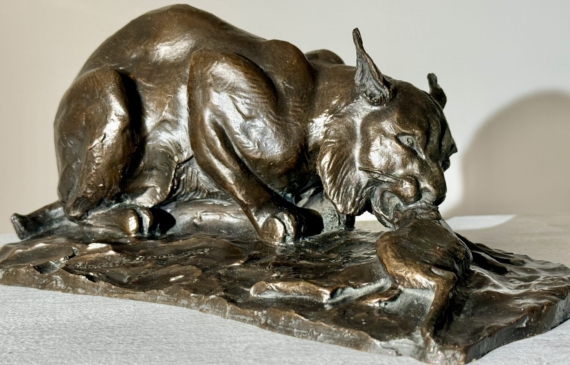
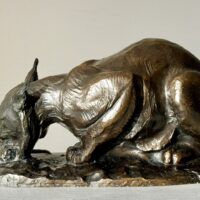
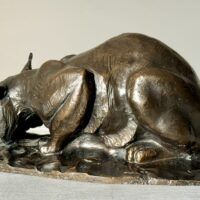
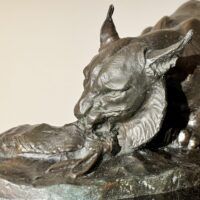
Lynx with Hare, 1923
Bronze, dark brown patina
5 ½ H. x 13 ¼ W. x 6 ⅞ D. inches
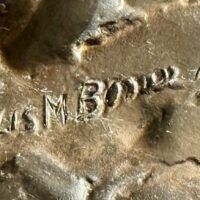
Signed on base: Phyllis M. Bone 1923
Phyllis Mary Bone showed a determined ambition from a very early age to make a career for herself in art. She trained at the Edinburgh College of Art beginning in 1912, gaining a Diploma in Sculpture in 1918. After studying under the animal sculptor Édouard Navallier in Paris for eighteen months, she returned to Edinburgh in 1919 where she was commissioned to work on the Scottish National War Memorial (1923-7), for which she was responsible for modelling all but one of the animals, including the Lion and Unicorn at the entrance.
Alongside these prominent projects Bone produced smaller animal sculptures, mostly in bronze, throughout her lengthy, prolific and successful career. She has been described as “the most productive [and] possibly the most connected female sculptor of the first half of the twentieth-century in Scotland.” In 1944 the quality of her work was acknowledged officially when she became the first woman elected a Royal Scottish Academician.
Bone’s animal sculptures were widely exhibited in Britain and Paris, bought for public and private collections, as well as by the government for a British Embassy. She also received several substantial commissions for architectural works in Edinburgh. Aside from the National War Memorial, these projects include a series of seventeen roundels containing reliefs of invertebrates and animals representing the principal zoogeographical regions for the Ashworth Laboratories, Edinburgh University (c. 1929) and lion and unicorn reliefs for the Scottish Office, St Andrew’s House, Regent Road (c. 1936).
When asked why she concentrated on sculpting animals, Bone replied, “All these creatures that fly from us shyly or threaten us fiercely interest me. I am enthralled by their shapes, their rhythmic movements, which, separately and combined, are so decorative and sculptural.” Her absorbing interest was the observation of wildlife which she exercised to the full on the estate of Penninghame, where she spent a great deal of time and she could also enjoy her great skill as a renowned salmon fisher.
Before she died in 1972, Bone was informed that her two bronzes in that year’s RSA Annual Exhibition had been sold, completing what must be a record of almost unbroken annual success for over thirty years.