
Paul Manship (American, 1885-1966)
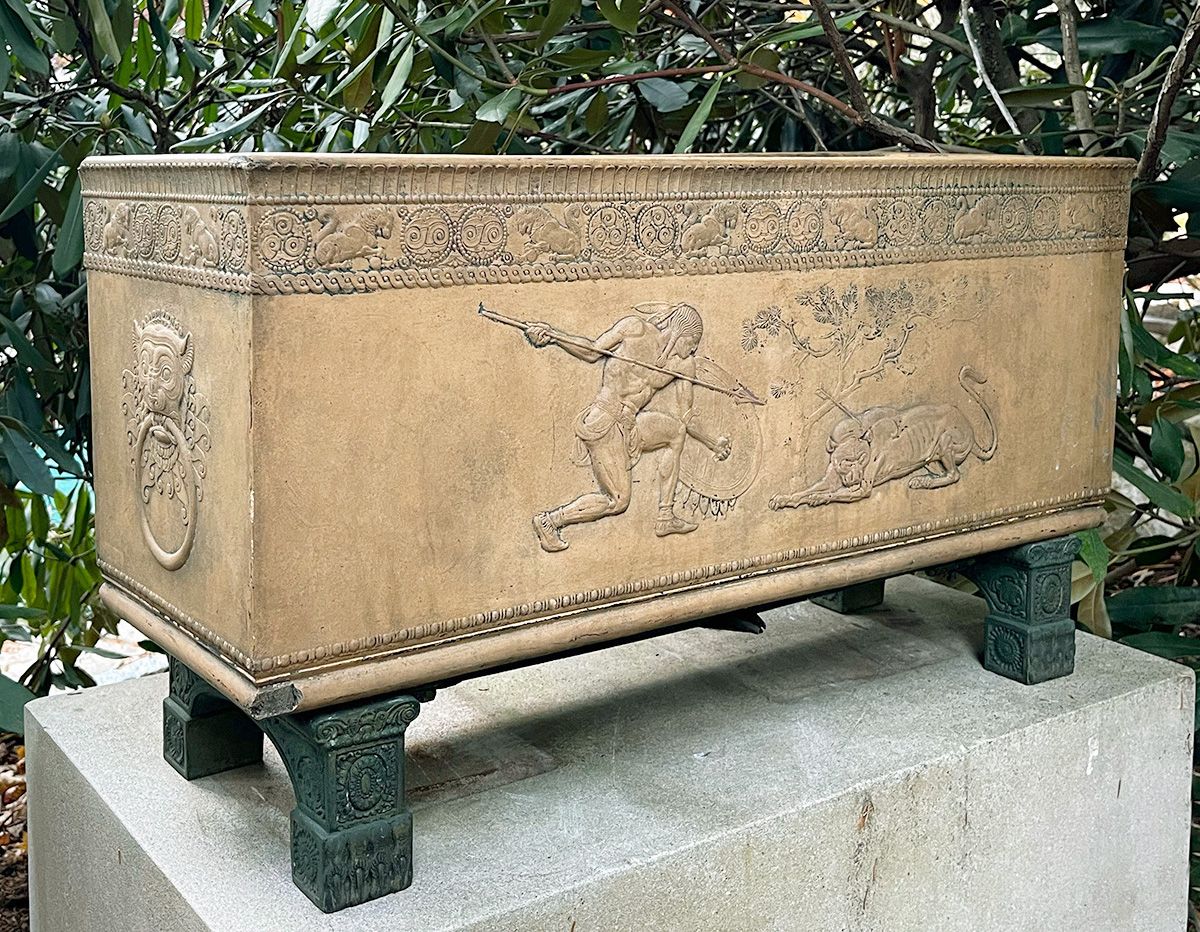
Flower Box, 1916
Terracotta with zinc liner, 12 H. x 29 ½ W. x 10 ½ D. inches
Cast by the Atlantic Terra-Cotta Company of Perth Amboy, NJ
Bronze stand: 5 H. inches, cast by Roman Bronze Works, New York
In good condition, consistent with age
Provenance:
The artist
John D. Rockefeller, Jr., New York
Stephen C. Clark, New York
Jane Forbes Clark, New York, by descent


10 West 54th Street, in the midst of its construction, 1912
In 1916, architect William Welles Bosworth commissioned six terracotta flower boxes to be made by Paul Manship for the home of John D. Rockefeller, Jr. at 10 West 54th Street in Manhattan. The seven-story, 102-foot tall structure was, at the time, the tallest private residence ever built in New York City, and these flower boxes greeted guests by the stair lamps of the inner vestibule on the first floor. Even so, in 1938, Rockefeller had the house demolished in order to make space for the expanding Museum of Modern, of which his wife, Abby Aldrich Rockefeller, was a founding trustee. The space where the house once stood, for only twenty-five years, is now MoMA’s renowned sculpture garden.

In this letter between John D. Rockefeller and architect William Welles Bosworth, Manship's estimate for the commission of six terra cotta flower boxes for his Manhattan home is discussed. The letter reads:
January 16, 1914
Dear Mr. Bosworth:
I am in receipt of your letter of January 10th enclosing copy of your letter of the same date, accepting Mr. Manship's estimate of $600. for furnishing six terra cotta flower boxes for the stair lamps in the inner vestibule of No. 10 West 54th Street. While this proposition is satisfactory to me, Mrs. Rockefeller will want to see the design for the boxes and pass on them before they are finally ordered.
Very truly,
John D. Rockefeller, Jr.
On the present example, one side depicts an antelope, bull, and fruited tree, the other a Native American hunter killing a mountain lion. The two short sides of the planter are decorated with bestial masks with ring “handles.” The upper register of the planter is adorned with a decorative lion frieze on all sides. The flower box sits atop a separate bronze stand with drainage tray; the stand is decorated with stylized vegetal and arabesque ornament.


In 1940, Stephen Clark, chairman of The Century Association at the time, purchased four of the Rockefellers’ flower boxes for the Association’s collection, where they remain today. A fifth, the current example, stayed in his own private collection and has since been passed down within the family. The sixth planter is currently unlocated.
The Clark family fortune came from the invention and early success of the Singer Sewing Machine Company. Generations of Clark family members have supported the arts, including Stephen C. Clark, who served as a trustee of both the Metropolitan Museum of Art and the Museum of Modern Art, as well as chairman of the Century Association. Multiple generations of the family have invested into the community of Cooperstown, New York, and have served on the board of the National Baseball Hall of Fame there. Stephen Clark’s personal collection included important works from Old Masters to Hudson River School to early modernism. Many of the pieces he collected by Impressionists are now in the collection of The Met.

The four planters from the collection of the Century Association, photographed in collection storage, New York.

Three of the flower boxes on display at the Century Association as part of a Paul Manship exhibition, December 2022.
The Century Association was founded in 1847 and named for the first 100 members, all with distinction in literature or the arts. Its artist members include Winslow Homer, Augustus Saint-Gaudens, Louis Comfort Tiffany, and John Quincy Adams Ward. Members are known for other endeavors, including eight Presidents of the United States, ten US Supreme Court justices, 43 Members of the Cabinet, and 29 Nobel Prize laureates. Paul Manship was elected President of the Century Association in 1950.
Two of the six Manship planters commissioned for 10 West 54th Street were exhibited at a solo show held at the Berlin Photographic Company at 305 Madison Avenue in 1916. This was Manship’s second solo show; the first had been held in 1913. The flower boxes were exhibited alongside numerous other Manship works, including a Centaur and Dryad sculptural group that had already been entered into the permanent collection of the Metropolitan Museum Art, attesting to Manship’s rising notoriety in the art world.
